

Next.js 14 New Features That Are Transforming Modern Web Development
Nov. 30, 2025
751

Table of Contents
According to React usage reports, over 1.3 million websites worldwide now use React-based frameworks, with Next.js experiencing over 3 million weekly downloads in 2024.
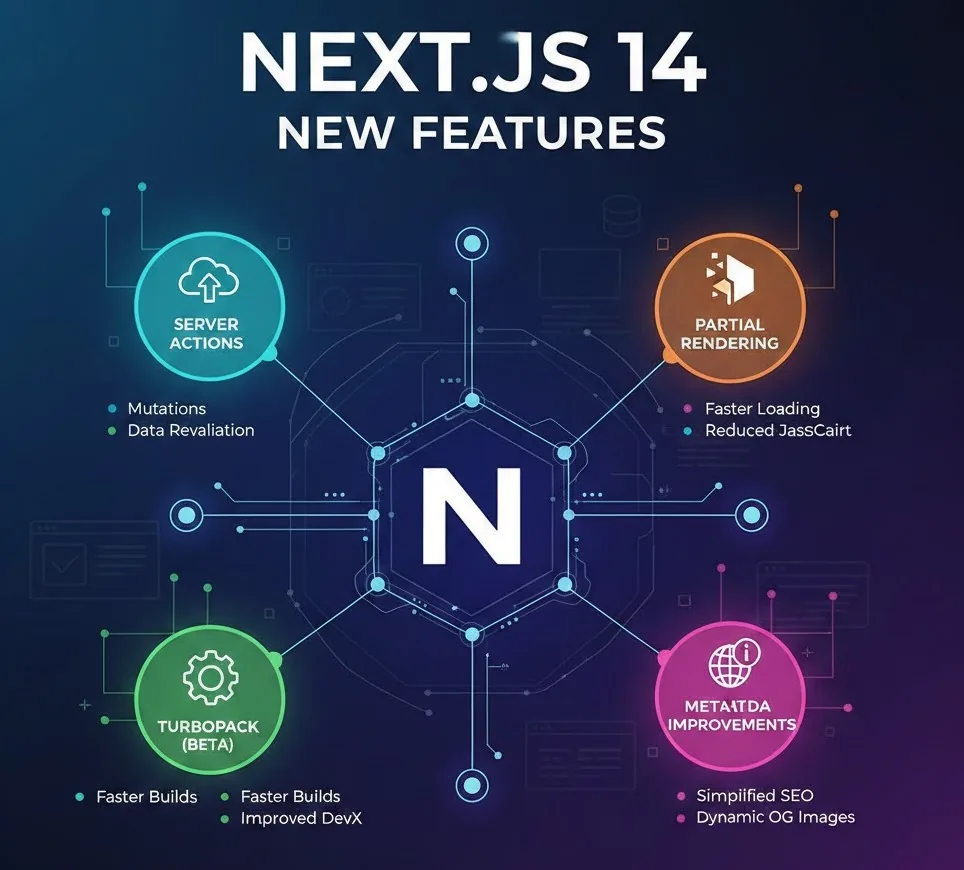
Next.js 14 has become the go-to framework for developers, bringing powerful new features that make coding easier and websites faster. Today's web projects need tools that are quick, can grow with your business, and are simple to work with. Next.js 14 delivers exactly that with updates like Turbopack for super-fast loading during development, Server Actions that let you handle data without creating complex APIs, and Partial Prerendering that gives you lightning-fast page loads with personalized content.
In this article, we'll look at how Next.js 14's revolutionary features are reshaping web development workflows, why they matter for your projects, and how leveraging professional Next.js development services can accelerate your digital transformation journey.
Key Takeaways
|
Feature |
Impact |
Benefit |
|
Turbopack (RC) |
53% faster local server startup |
Improved developer productivity |
|
Stable Server Actions |
Simplified data mutations |
Reduced API complexity |
|
Partial Prerendering |
Fast static response + dynamic content |
Best of both worlds performance |
|
Enhanced Caching |
Configurable invalidation periods |
Better control over content freshness |
|
React 19 Integration |
Latest React capabilities |
Future-ready applications |
Let's dive into one of Next.js 14's most exciting improvements: Turbopack. It's a fundamental rethinking of how bundlers should work. According to a source, during development, Turbopack delivers 53% faster local server startup and processes code updates with Fast Refresh that's 94% faster than previous versions.
For developers working on large-scale applications, this translates to dramatically reduced wait times. The Vercel team tested Turbopack on their own production website and observed significant performance gains that directly impact daily development workflows. With over 5,000 integration tests now passing, including seven years worth of bug fixes and edge cases, Turbopack represents a mature solution ready for production environments.
Read this The Ultimate Guide to Budgeting for Your Next Chatbot Project: Tips and Strategies
Server Actions
Server Actions represent a shift in how developers handle data mutations and form submissions. Before Next.js 14, creating interactive features required manually setting up API routes, handling request validation, and managing error states.
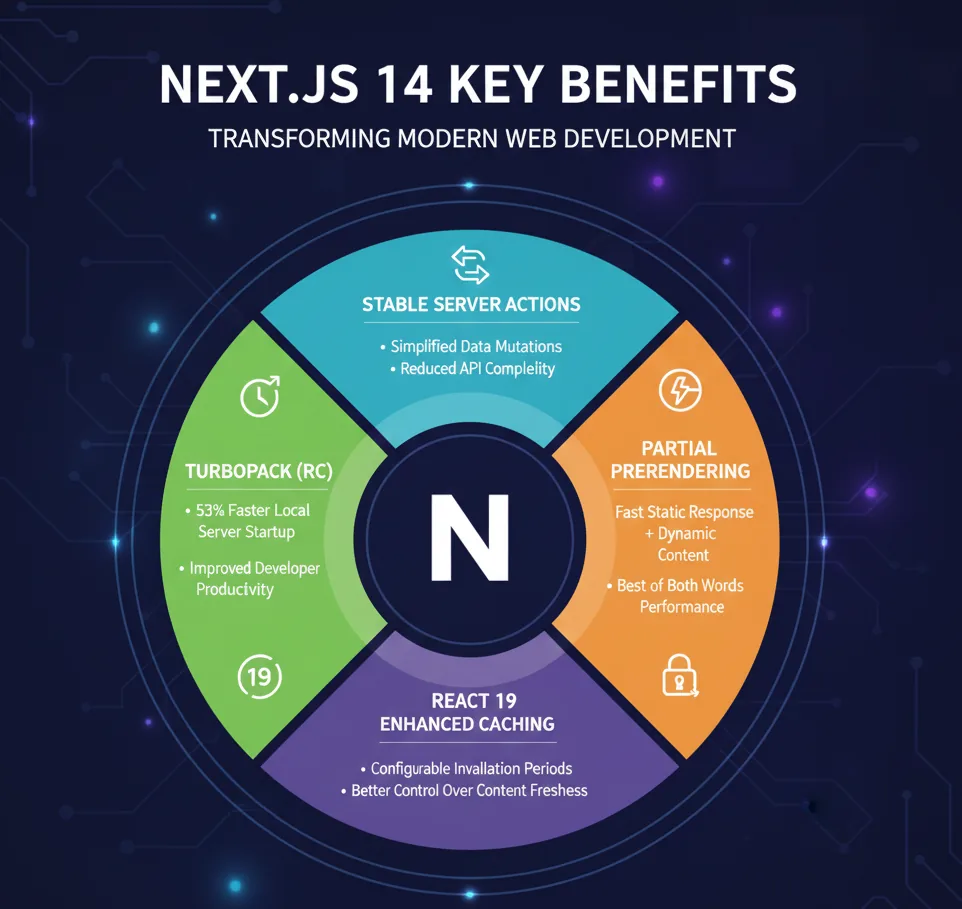
With stable Server Actions, you can define functions that run securely on the server and call them directly from React components. No more context switching between frontend and backend code. No more boilerplate API endpoints for simple operations. For businesses seeking Next.js development services, this feature reduces project timelines while improving code maintainability. Your development team spends less time on plumbing and more time on features that directly impact user experience.
Partial Prerendering
Partial Prerendering solves a decade-old issue in web development: how do you deliver both lightning-fast initial page loads and personalized dynamic content without compromising either? Traditional approaches forced developers to choose between static site generation for speed or server-side rendering for personalization.
Next.js 14's Partial Prerendering builds on years of research into SSR, SSG, and ISR to create a compiler optimization that delivers fast initial static responses while supporting fully dynamic, personalized content. The framework uses React Suspense to define which parts of your page should be statically prerendered and which need dynamic loading.
What Performance Improvements Should You Expect in Production?
According to web performance research, even small improvements in load time significantly impact conversion rates and user engagement.
Beyond development speed, Next.js 14 delivers substantial production optimizations. The framework introduces enhanced tree-shaking for Server and Client Components, automatically removing unused exports.The caching system received major upgrades with configurable staleTimes for the client-side router cache.
Memory usage during builds decreased substantially through optimized algorithms and better resource management. CSS optimization received improvements that reduce stylesheet bloat. These might seem like technical details, but they translate directly to faster page loads, better SEO rankings, and improved user satisfaction.
For organizations considering progressive web app development or mobile application modernization, these performance gains become competitive advantages. Users perceive faster sites as more professional and trustworthy, directly impacting business metrics.
Developer Experience Improvements
Next.js 14 focuses heavily on making developers' lives easier. Error messages received complete overhauls with better hydration mismatch diagnostics and improved visual design. When something goes wrong, you get clear, actionable information instead of cryptic stack traces.
The addition of pushState and replaceState support means you can update browser history without page reloads, perfect for implementing filters, sort options, and other state that should persist across sessions. Image optimization expanded to support the picture element, art direction, and dark mode variations, common requirements that previously needed custom solutions.
Documentation improvements include comprehensive self-hosting guides covering Node.js servers, Docker containers, and static exports. The team added detailed sections on runtime environment variables, custom cache configuration, and image optimization for those hosting outside Vercel's platform.
These quality-of-life improvements might seem minor individually, but collectively they represent hundreds of saved hours across a development team's yearly workflow. When you partner with experienced frontend development specialists, they leverage these efficiencies to deliver projects faster and with fewer issues.
What About Integration with Modern Tools ?
Next.js 14 maintains strong compatibility with the tools developers already use in their workflows. The framework integrates smoothly with TypeScript for improved error detection and IDE support, while popular testing frameworks like Jest and React Testing Library work seamlessly for comprehensive test coverage.
The framework supports multiple styling approaches including Tailwind CSS, styled-components, and CSS Modules. Teams can continue using their preferred styling methodology without needing to adopt new systems or change their existing workflows.
Edge computing capabilities allow you to deploy application components on servers closer to your users' geographic locations. A user in Tokyo connects to an Asian server while someone in New York accesses a nearby server, resulting in faster load times regardless of location.
Next.js 14 scales effectively for projects of any size, from small business websites to enterprise platforms serving millions of users. The framework adapts to your specific requirements rather than imposing rigid constraints. For companies undergoing digital transformation, this flexibility allows integration with existing infrastructure without requiring complete system overhauls.
Conclusion
Next.js 14 represents more than just another framework update, it's a comprehensive reimagining of what modern web development should be. By combining Turbopack's blazing speed, Server Actions' simplicity, and Partial Prerendering's performance optimization, it addresses the core challenges developers face daily.
Choosing CodeSuite for your Next.js development services means partnering with experts who understand these technologies and know how to leverage them for maximum business impact. Our team specializes in building high-performance web applications that scale with your business needs.
Ready to transform your web presence? Reach out to us for a consultation on how our web development services can accelerate your project timelines while delivering exceptional user experiences.
Frequently Asked Questions
Q: What is Next.js 14's main improvement over previous versions?
A: Next.js 14 focuses on performance and developer experience with Turbopack for faster development, stable Server Actions for simplified data handling, and Partial Prerendering for optimal rendering strategies without complexity.
Q: Is Next.js 14 suitable for large enterprise applications?
A: Yes, absolutely. Next.js 14's enhanced performance, improved caching mechanisms, and production optimizations make it ideal for enterprise-scale applications requiring both speed and scalability.
Q: Do I need to rewrite my existing Next.js app to use version 14?
A: No, Next.js maintains backward compatibility. You can upgrade incrementally and adopt new features like Server Actions and Turbopack gradually without major refactoring.
Q: How does Turbopack compare to Webpack?
A: Turbopack offers significantly faster compilation speeds up to 700 times faster on large applications—while maintaining feature parity with Webpack for most common use cases.